Why We Did This
Every vodka brand claims to be smooth. Very few are willing to prove it. So we stopped talking and sent our vodka to a laboratory — alongside Grey Goose, Belvedere, Tito's, Kettle One, and Platinum 7 — for Gas Chromatography / Mass Spectrometry analysis.
Every sample was submitted blind. The lab received six numbered 50 ml bottles with no brand names attached. They had no idea which sample was ours, and no way to produce a favorable result even if they wanted to.
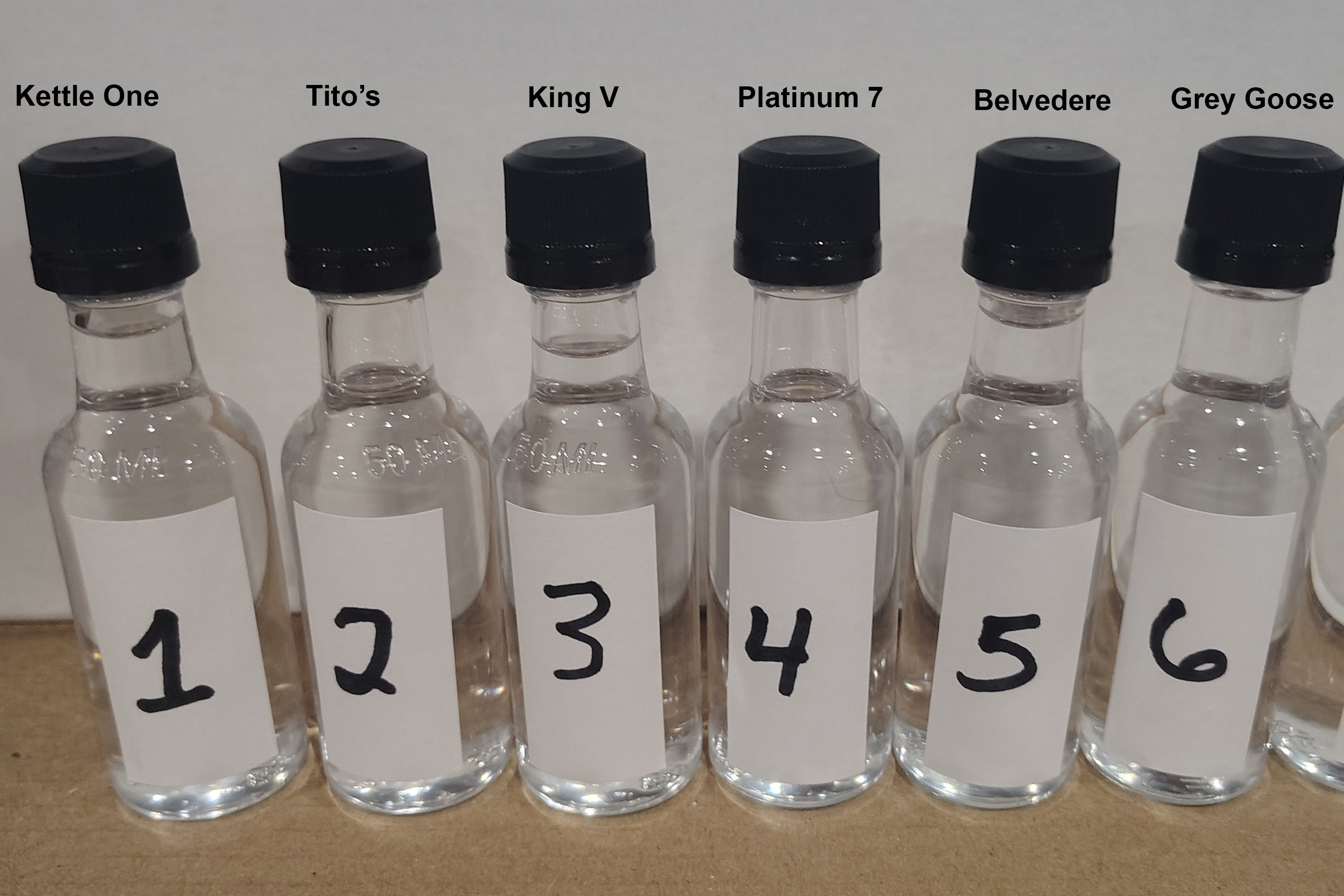
The six samples exactly as they were mailed to the lab — numbered only, no brands.
What GC/MS Actually Measures
Gas Chromatography separates a liquid into its individual chemical components. Mass Spectrometry then identifies each one. Together they produce a chromatogram — a graph where every peak represents a distinct compound present in the sample.
In a vodka, one enormous peak is expected: that's the ethanol. Everything else that shows up is a congener — acetaldehyde, methanol, fusel oils, esters, and other byproducts of fermentation and distillation. These are the compounds most associated with harshness, off-flavors, and next-morning regret.
Fewer peaks means a cleaner spirit. Where those peaks sit matters too. A small peak landing immediately beside the ethanol is usually just the edge of that enormous signal. A peak that appears well away from it — early in the run, or late — is a genuinely separate compound the spirit is carrying.
The Results
| Sample | Vodka | Additional Peaks Detected | Result |
|---|---|---|---|
| #3 | KING V | 1 trace peak (4.402 min) | Cleanest |
| #2 | Tito's | 1 trace peak (4.382 min) | Cleanest |
| #6 | Grey Goose | 1 early-eluting peak (2.391 min) | Minor congeners |
| #5 | Belvedere | Cluster of peaks after ethanol (~4.4 min) | Minor congeners |
| #1 | Kettle One | Multiple, incl. 9.430 & 10.698 min | More congeners |
| #4 | Platinum 7 | Multiple across full range | Most congeners |
KING V tested in the cleanest tier — beating Grey Goose, Belvedere, Kettle One, and Platinum 7.
KING V and Tito's came back essentially indistinguishable: both showed a flat baseline with a single trace peak just after the ethanol. Every other vodka in the group showed more. Not cleaner "for the price" — cleaner than bottles selling for two to three times as much. That is what Top Shelf Vodka for a Bottom Shelf Price looks like on a chromatogram.
See It For Yourself
We are publishing every chromatogram, unedited, including the ones for our competitors. Look at the baseline on each graph — that flat line running along the bottom. Every tick mark on it is a compound that isn't ethanol.
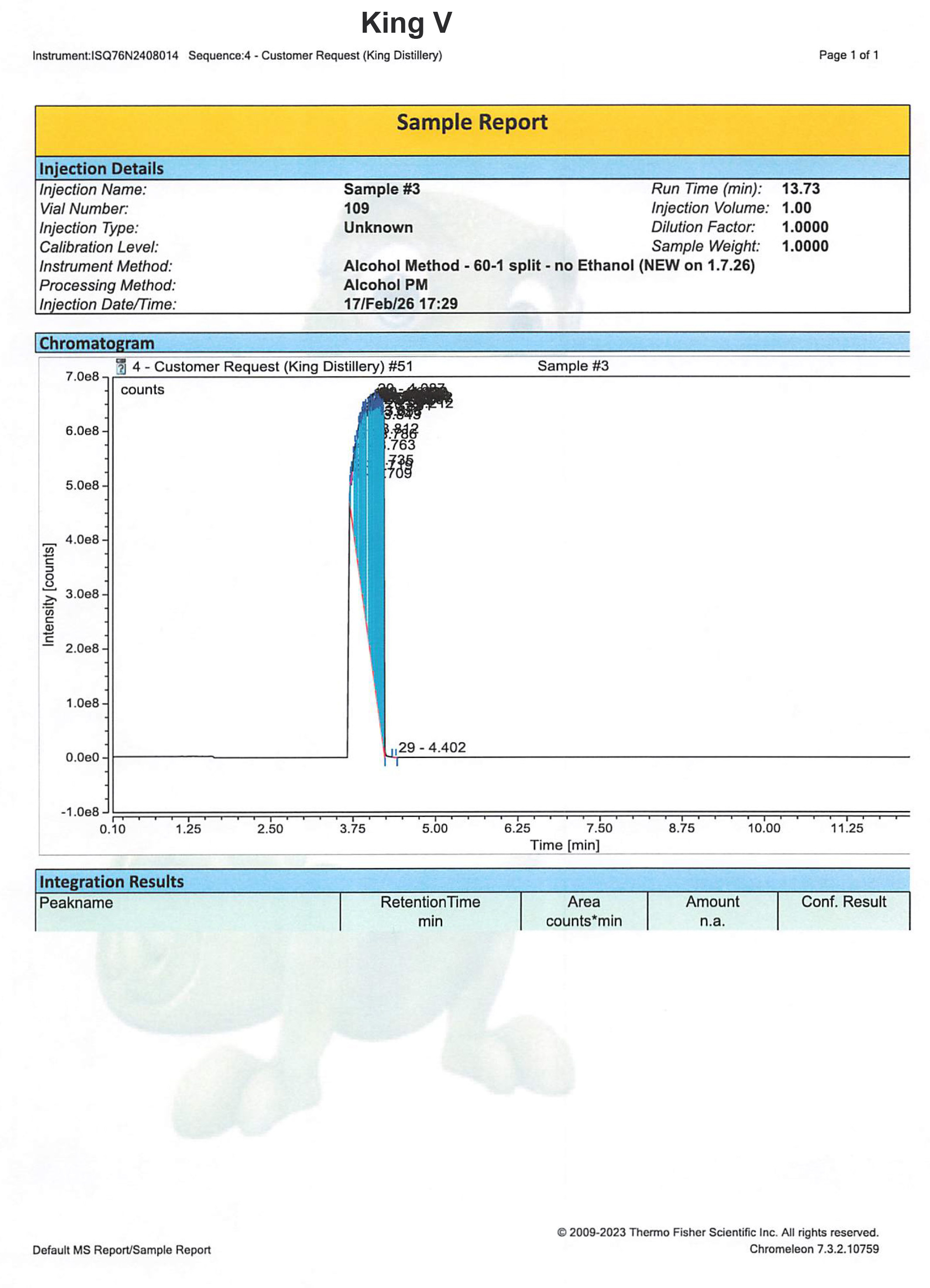
KING V — Sample #3
Clean baseline. Single ethanol peak.
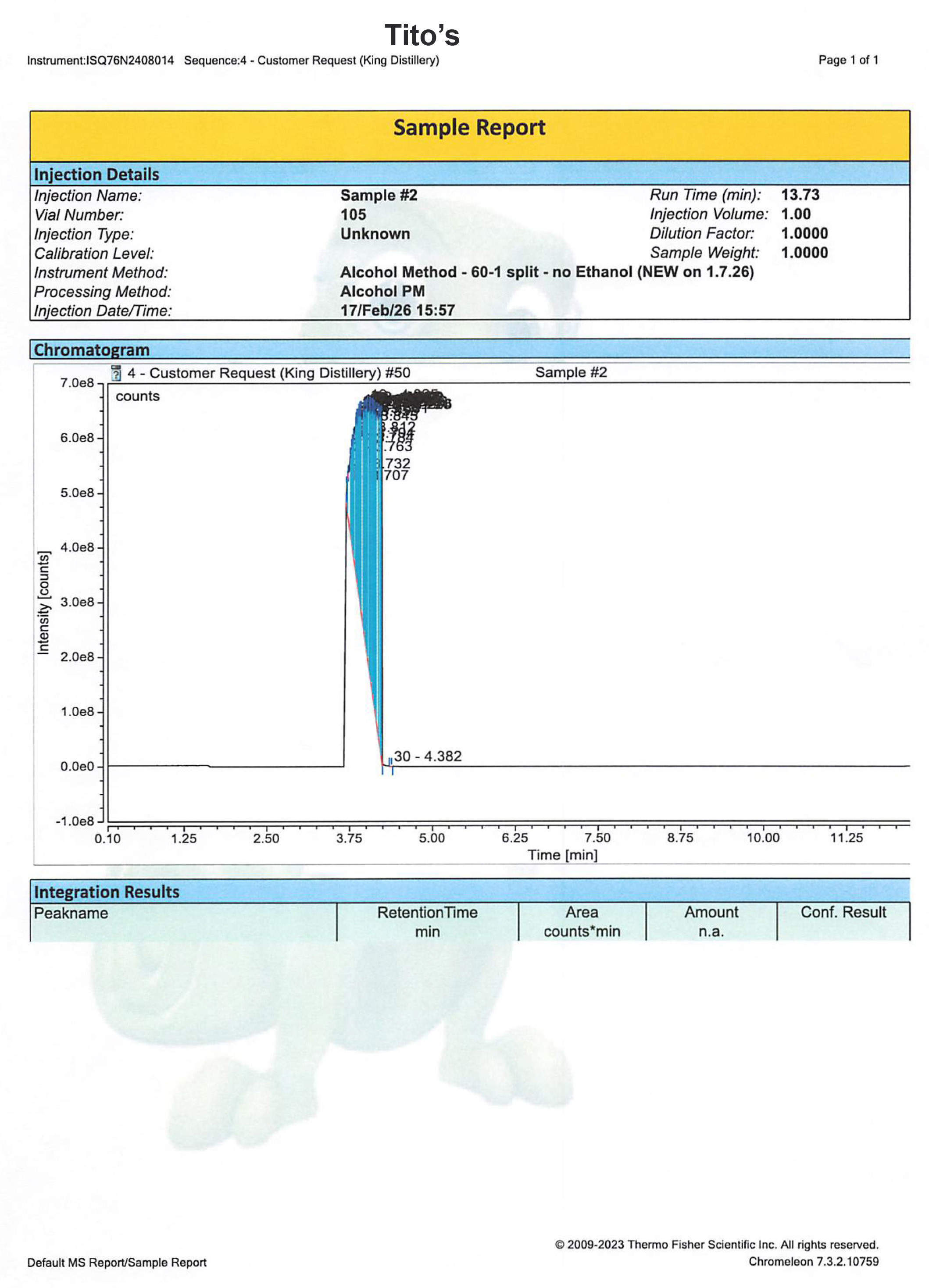
Tito's — Sample #2
Clean baseline. Single ethanol peak.
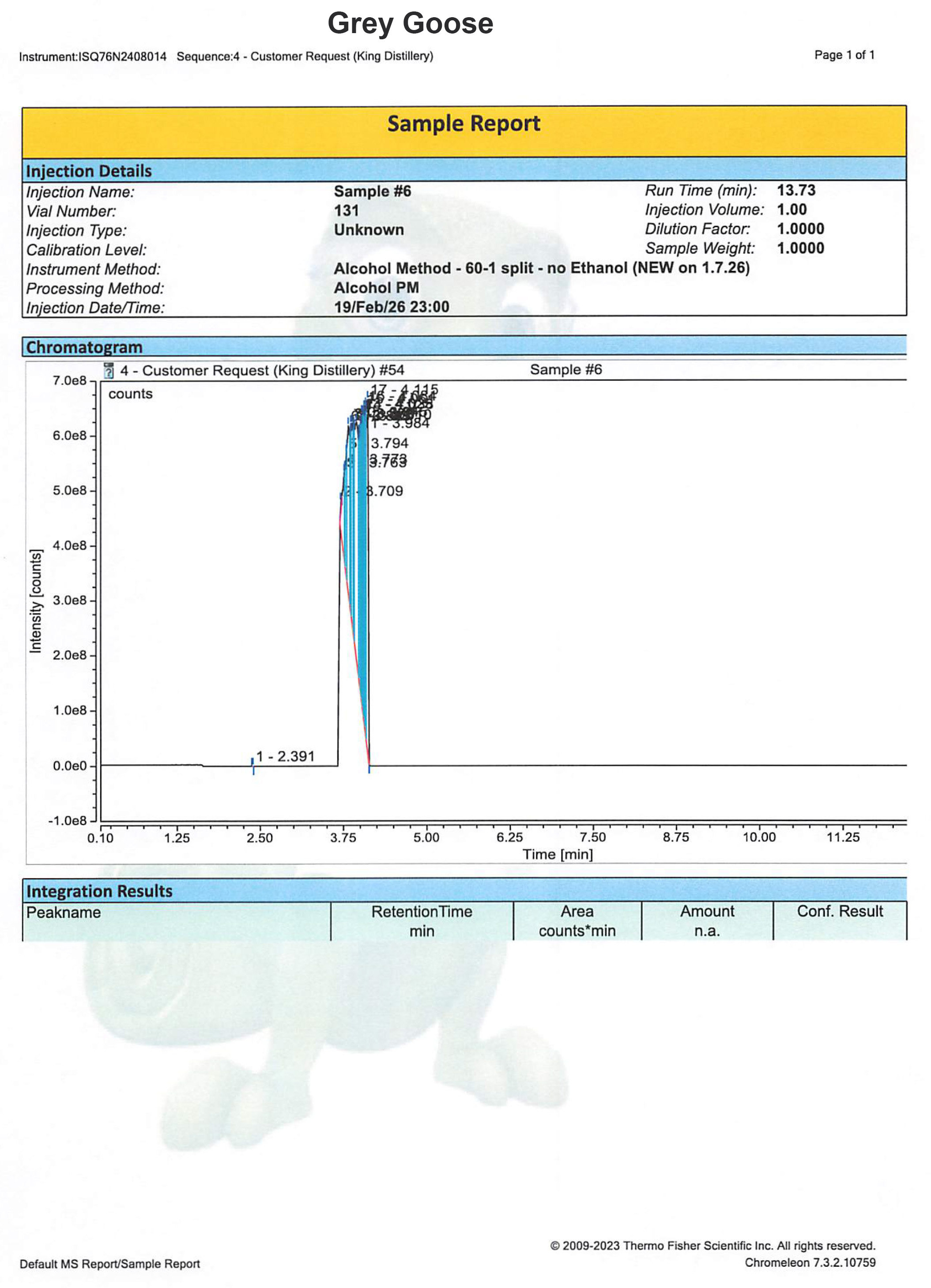
Grey Goose — Sample #6
Early-eluting peak at 2.391 min.
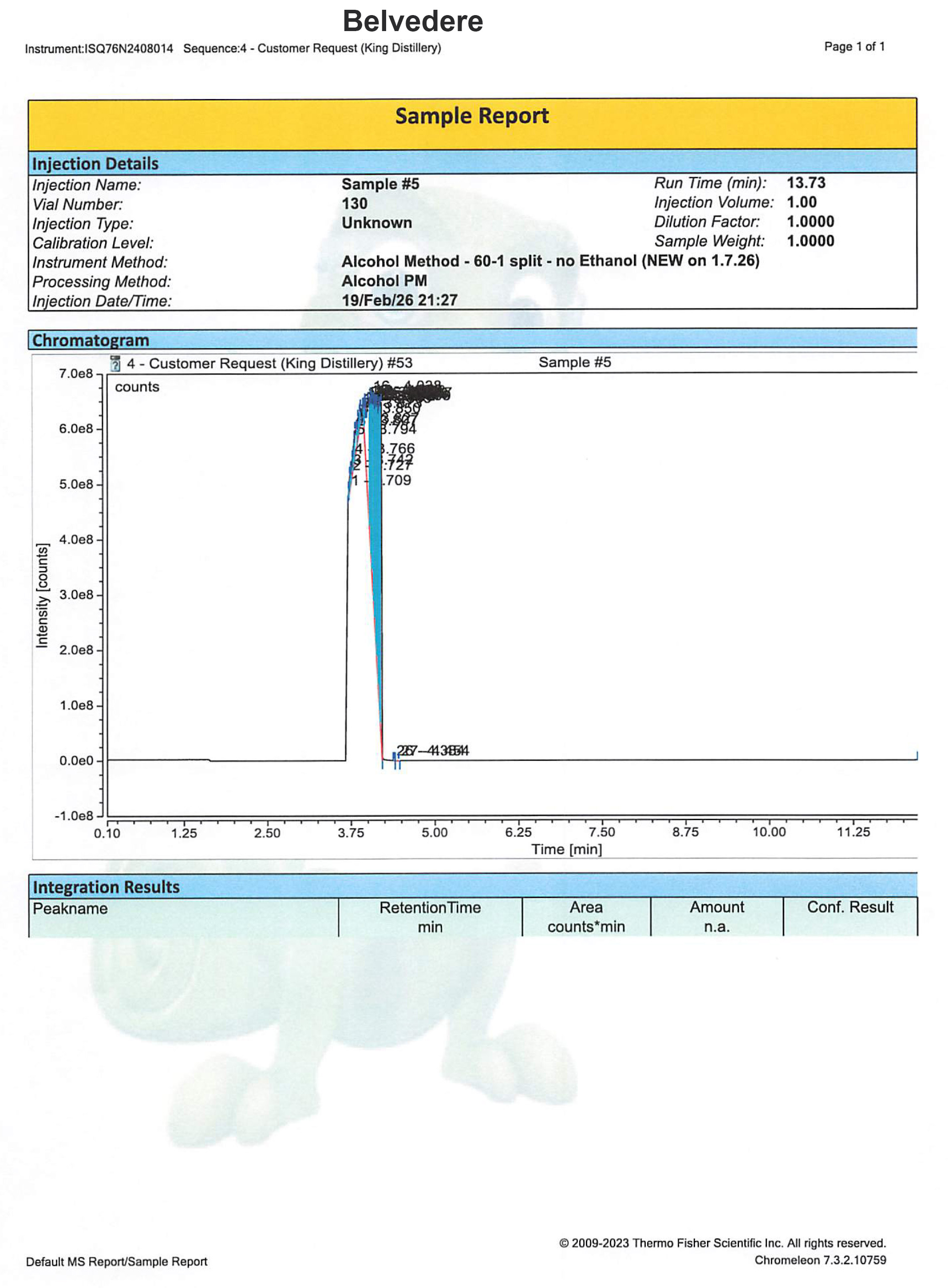
Belvedere — Sample #5
Cluster of congener peaks after ethanol.
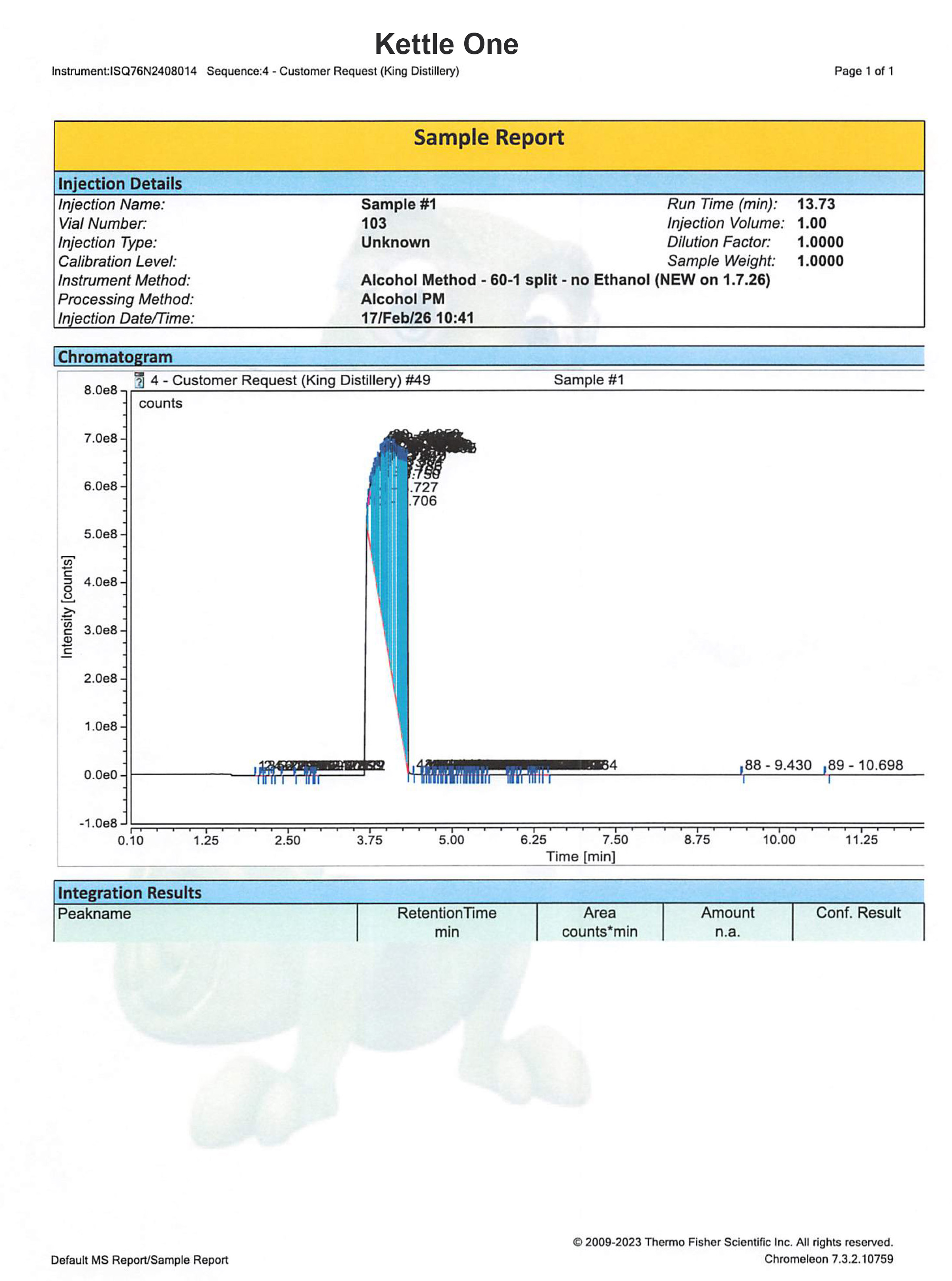
Kettle One — Sample #1
Late-eluting peaks at 9.430 & 10.698 min.
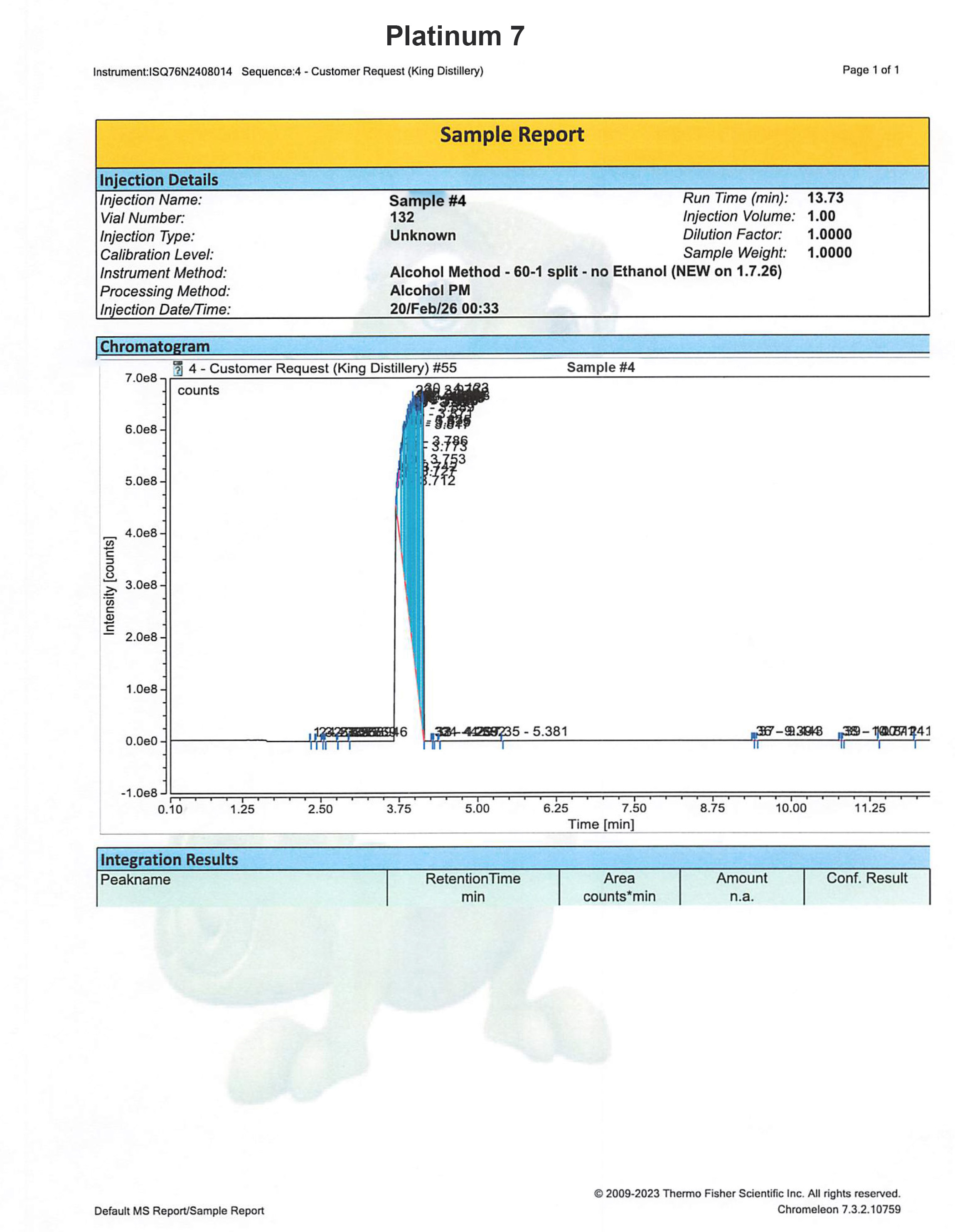
Platinum 7 — Sample #4
Multiple peaks across the full run.
Method: Analysis performed on a Thermo Scientific ISQ series GC/MS (Instrument ISQ76N2408014) using the Alcohol Method, 60-1 split, ethanol suppressed. 1.00 µL injection volume, 1.0000 dilution factor, 13.73 minute run time per sample. Samples submitted blind and numbered 1–6. Data processed in Chromeleon 7.3.2. Samples run February 17–20, 2026. Chromatograms reproduced exactly as received from the laboratory. Comparisons above are based on peak presence in the chromatographic baseline; quantitative concentrations were not part of this analysis.